
Discover Sherwood Forest
Find out more about Sherwood Forest, Robin Hood, visiting the forest, and events.
Robin Hood’s tree dies but leaves huge legacy after more than a millennium of life.
5 min read
A tree, thought to be up to 1,200 years old, at the heart of Sherwood Forest and linked to the legend of Robin Hood is believed by experts to have died.
The gigantic Oak tree, known as the Major Oak, has been in visible decline for several years, despite tireless efforts to improve its health and prolong its life. This spring, the Major Oak failed to come into leaf and is now believed to have died.
Although this marks the end of the Major Oak as a living tree, it does not mark the end of its story. The iconic oak tree remains a powerful presence in the landscape and an enduring part of our cultural heritage. The tree and soil beneath it will continue to be a vital refuge for wildlife and the knowledge we have gained by looking after the Major Oak will help preserve other ancient oaks across the country. Its legacy will live on through its saplings and the legends associated with it, with plans being drawn up with our partners, and the tree will continue to be a vital refuge for wildlife.
Watch our film to hear the history of the Major Oak and learn about its enduring legacy.

For centuries, the Major Oak has been woven into the story of Sherwood Forest and the legend of Robin Hood. With a trunk circumference of around 11 metres and a crown of 28 metres, it captivated imaginations and sparked an affection that saw it win the Woodland Trust’s Tree of the Year title in 2014.
The Major Oak was also the very first tree recorded on the Woodland Trust’s Ancient Tree Inventory. Ancient oaks, the name given to oaks when they reach 400 years old, are biodiversity powerhouses, providing food and shelter for hundreds of species of insects, fungi, birds and mammals.
Sherwood Forest holds one of the largest concentrations of ancient and veteran oaks in Western Europe. Protecting the remaining trees and nurturing the next generation of ancient and veteran trees is essential for the future health of the forest and the survival of many rare and threatened species.
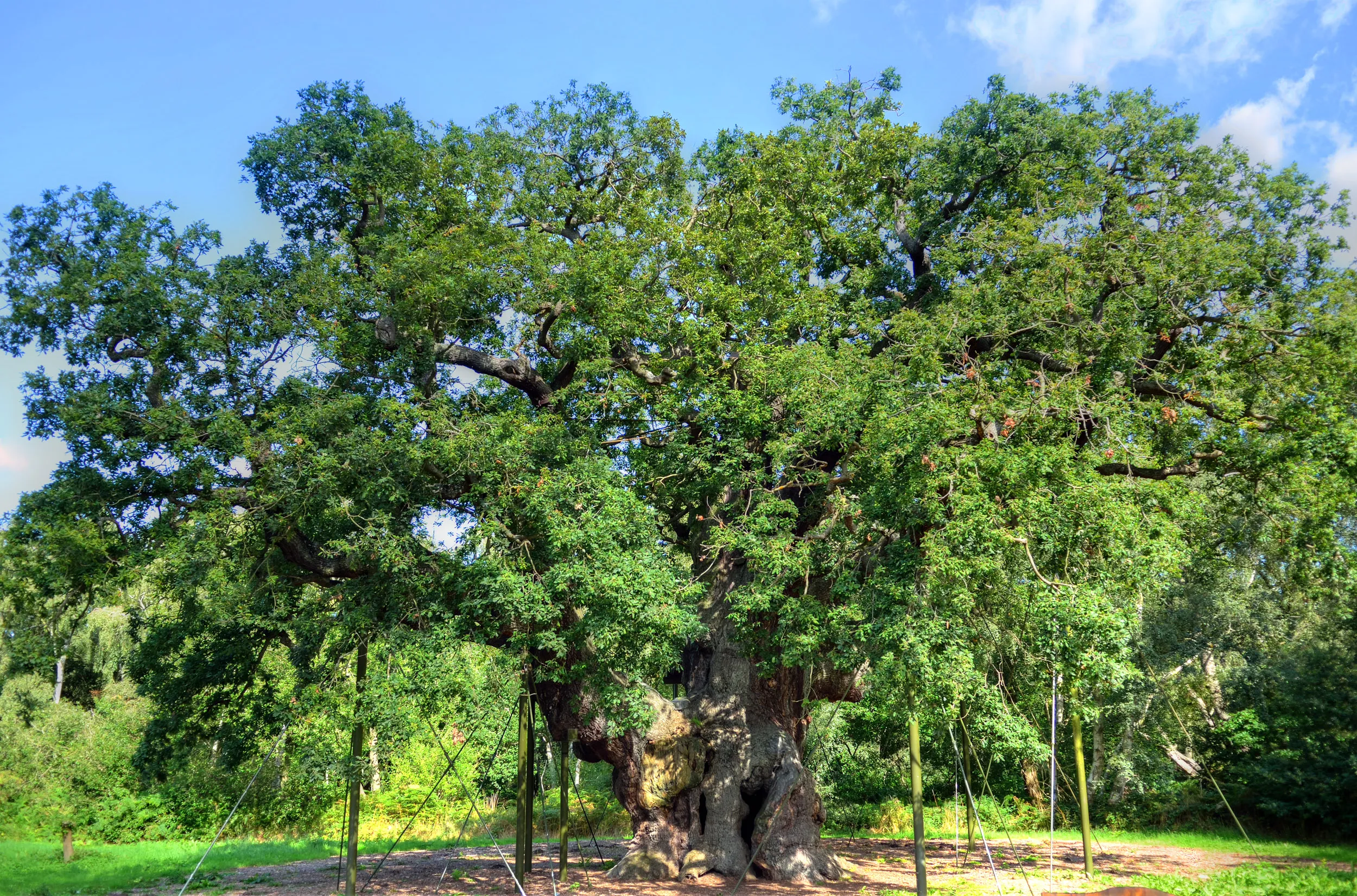
It is impossible to determine one exact cause of the oak’s demise, as it is the result of a complex combination of issues. For more than a century, well intentioned efforts to preserve the tree’s impressive shape – including metal bracing, props, concrete and coverings – prevented it from ageing naturally and in fact created added challenges to its survival. Millions of visitors also compacted the sandy soil around its roots, making it difficult for water, nutrients and oxygen to reach the tree.

Recent investigations carried out by the site team with the UK’s leading soil scientists and arboricultural experts, revealed that the soil was extremely hard and lacking in life, and the root system was far smaller and weaker than earlier scans suggested. This combination of poor soil, human interventions and a weakened root system has been a major factor in the decline of the Major Oak.
Additionally, climate change and the associated recent heat waves and droughts have compounded the challenges faced by the tree.
The RSPB took on the management of Sherwood Forest in 2018, and since 2021 we have worked with leading soil and tree experts to understand the true condition of the Major Oak.
A pioneering programme of work to improve the condition of the soil around the tree’s roots has helped restore the health and biodiversity of the soils surrounding the Major Oak, reconnecting it to the wider woodland. Whilst still valuable to the variety of nature in the area, sadly, for the Major Oak itself, these improvements came too late.
However, the knowledge we have gained is invaluable. We now have a far deeper scientific understanding of why the Major Oak declined, and we’re continuing to study the relationship between ancient trees and the soils that sustain them.
These lessons will help us, and our partners, champion better protection and management for other ancient and veteran trees in Sherwood Forest and across the UK and beyond.
The Major Oak will remain standing for many years, continuing as an emblem in the landscape and providing valuable decaying wood habitat – one of the reasons Sherwood Forest is protected by law. Sherwood Forest is home to one of the largest collections of ancient oaks in Western Europe, a stronghold for specialist species that rely on these green monuments for survival. When the tree eventually collapses, it will return nutrients to the soil and support new life, completing its natural cycle.
Although this marks the end of the Major Oak’s life as a living tree, its story is far from over. Acorns and cuttings from the tree have been grown into saplings, and plans for the future are being explored with our partners. There are Major Oak saplings planted in locations right around the world, so we are planning work to ensure that its offspring will grow and generate their own acorns – and legends – for centuries to come.

The site team and the experts caring for the Major Oak will continue to monitor the ecology of the tree and its surrounds, as well as the structural safety of the tree. They will also continue to expand their learnings by completing the planned work around the base of the tree, helping to revitalise the soil and improve the biodiversity of the forest as a whole. This work will deepen our expertise and further shape how we can care for ancient trees around the world.
The Major Oak will always be part of the story of Sherwood Forest and the legend of Robin Hood. Its presence and its symbolism will continue to inspire care, respect and a deep connection to nature for generations.
And at the RSPB, our commitment to Sherwood Forest and its ancient trees remains as strong as ever.

“Whilst the tree’s failure to produce leaves this year is heart-breaking for everyone – from the many people over the years who have looked after this magnificent tree to the millions who have travelled here to see it – we know the Major Oak will have a lasting legacy, first and foremost because it is so inextricably linked to Robin Hood and Sherwood Forest.
"But beyond its cultural heritage, the Major Oak will continue to provide important habitat for wildlife, reminding us why these remarkable trees are so important and why protecting them for the future matters.
“The invaluable knowledge gleaned from taking care of this beloved tree will inform best practises in how we look after ancient oak trees going forwards, not just here but around the world.
“The Major Oak will continue to stand at the heart of Sherwood as a natural monument for visitors to come and see, living on in the legend of Robin Hood and continuing to provide as much support to the forest’s ecosystem in death as in life.”
“Ancient trees like the Major Oak are the ‘conservation white rhinos of the UK’ but their decline is far less visible. Saving them is vital to the health of the world we live in and yet most disappear quietly, without the recognition or care given to the Major Oak.
“The Major Oak was the very first tree recorded on our Ancient Tree Inventory, but recording trees alone will not halt their catastrophic decline. We urgently need stronger legal protections for our ancient woods and trees, as well as more investment in their active care.”
You can find out more about the Major Oak, as well as answers to frequently asked questions here.
For more information about Sherwood Forest, please visit Sherwood Forest.
Find out more about Sherwood Forest, Robin Hood, visiting the forest, and events.

Mapping the oldest and most important trees in the UK.


