
News
The Government takes positive steps towards bird of prey protections
It has announced a call for evidence to assess the impacts of gamebird shooting.
8th Oct 2026
To mark World Albatross Day, Adam Charlton from the RSPB Marine Team, looks at global efforts to save these remarkable birds.
5 min read
It starts as a white dot in the two-tone expanse of blue. At such a distance, few living things are visible to the human eye, but this is, and it’s growing larger.
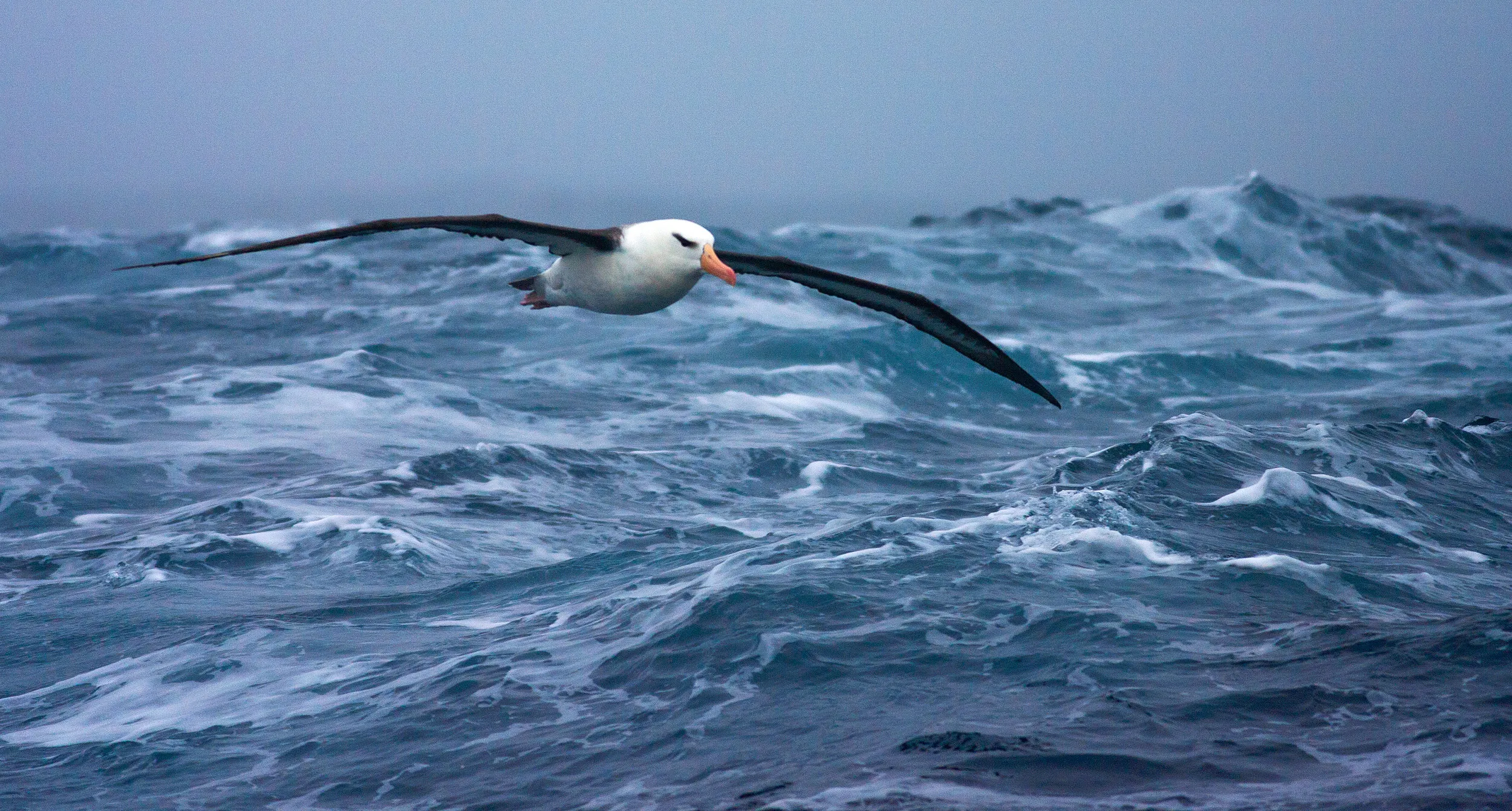
Detaching itself from the pale sky, the vast wings of a Wandering Albatross arc towards the waves of the Southern Ocean. This mighty bird is a thousand miles from the nest where its hungry chicks are waiting, carried on the trade winds in search of food.
Travelling fast now, it skims the frothing waves, guided by the scent of a shoal, scanning for the glint of a fish. Then, it dives. Beneath the surface, the albatross has caught its prey, but within this fish is a six-inch steel hook. The wanderer drowns unseen; dragged down by a line 70 miles long, and set with three thousand hooks just like that one.
Throughout the world’s oceans, countless albatrosses are killed like this every year. Getting caught as ‘bycatch’ in fishing gear is the greatest threat to seabirds globally, and, alongside the impact of invasive species, is the reason 15 out of 22 species of albatross are on the IUCN Red List. Hosted by the RSPB, the BirdLife International Marine Programme is working to halt and reverse this alarming trend.
For World Albatross Day, 19 June 2026, we caught up with their fight to save albatrosses.
.jpg)
Whether in coastal waters or the depths of the open ocean, fishing is a constant presence in our seas. Any given year, more than 40% of the ocean is within 18 miles of a baited hook, the distance at which an albatross can smell its prey. With their capacity to cover great distances, albatrosses risk encountering a tuna longline (like the one described above) frequently throughout their adult lives. Even if they evade the hooks, they risk being struck and killed by the cables which drag trawl nets. When the parents fail to return, the chicks die. The result is a decline in the populations of several highly vulnerable species.
The good news is that there are methods and technologies which can massively reduce the rate at which albatrosses and other seabirds are killed in fishing operations.
The BirdLife International Marine Programme has pioneered these mitigation efforts, helping crews on board fishing boats from Norway to Argentia to reduce bycatch. Such efforts have resulted in a staggering 98% reduction in seabird bycatch in Namibian waters. This is similar to previous efforts in South Africa, with both their areas being vital feeding grounds for albatrosses.
The ongoing challenge is to roll this out globally. Years of campaigning means that international legislation already exists to protect seabirds from bycatch. Now, the Marine Programme is working to ensure this translates into real-world change for albatrosses.
Beyond the 200 nautical miles of coastal waters managed by nation states are the ‘High Seas’. Covering over half the planet, the High Seas are shared by all and stewarded by none alone. Protecting albatrosses as they traverse these vast expanses of open ocean is central to stopping their decline. An astonishing 95% of fishing on the High Seas is currently unmonitored, and the Marine Programme is working to change that.

The team has highlighted gaps in chartering agreements between countries like Namibia, Spain and Taiwan, provided training on seabird, shark and turtle identification, and supported the adoption of clearer bycatch reporting forms for onboard observers. This helps to identify who is responsible for the safety of seabirds when a boat is operating in areas far from its home port. These efforts are already leading to better bycatch monitoring. By increasing transparency and accountability on the High Seas, the programme is pioneering a practical model that can be expanded to other fleets, helping to better understand how and where albatrosses are most at risk.
This work is taking place as a ground-breaking UN agreement enters into force. Campaigned for by the Marine Programme, the ‘Biodiversity Beyond National Jurisdiction Treaty’ is designed to ensure the conservation and sustainable use of the High Seas. It allows the designation of marine protected areas in these vast parts of the ocean beyond national waters, and represents an important opportunity to strengthen global conservation strategies for migratory species, including albatrosses and petrels.
The Marine Programme is providing technical support to identify and develop the best strategies to help albatrosses and other species under the Treaty. Working at the forefront of marine conservation, the programme has ensured that seabirds are recognised as indicators of ocean ecosystem health, and mapped the interaction between breeding sites, feeding grounds, migration routes, and fishing fleets. This data supports Treaty signatories to build a case for bigger and better-connected protected areas on the High Seas.
Some systems offer powerful leverage alongside regulations introduced by national and regional authorities. The seafood supply chain encompasses the globe, and drives sustainable fishing incentives. While the scale can seem daunting, the Marine Programme works to harness this massive consumer power for positive change.

The Marine Stewardship Council (MSC) fish label helps consumers to find and choose sustainable seafood products. When a fishery applies for certification, the Marine Programme engages to ensure it meets strict criteria in regard to seabird bycatch. This involves collating massive amounts of data, and assessing fisheries across the world.
The programme has engaged with 37 fisheries through this process, directly resulting in over 65 seabird bycatch conditions on fisheries seeking certification, and leading to better fishing practices that have a lower impact on seabirds.
Achieving systemic change is never quick or easy. Yet the Marine Programme’s capacity to work at every level of the fishing industry, develop and support policy, gather and map data, provide guidance to captains and observers, and leverage the seafood supply chain, is vital in the fight to save albatrosses.
The enormity of the fishing industry, and the oceans within which it operates, means there is no one solution to its impact on albatrosses. The only solution is to enable change from fishing crews through to seafood consumers. The Marine Programme has proved how effective mitigation can be in countries like Namibia. It’s now about making mitigation a global norm.


