Ask an RSPB expert: your April questions answered
Our expert, Alex Wilkins, answers some of this month's most commonly asked questions.

On this page
You may have noticed that the birds are getting noisier this month. Alex explains what's happening and answers your bird song questions.
Why do birds sing?
Bird song and calls provide a variety of different communication methods for birds. Birds start to sing in the lead up to the breeding season in order to attract a mate. Their songs are a way for them to demonstrate they are healthy and would make a good partner.
Birds also sing to defend their territories. This happens mostly during the breeding season but species such as Robins will fiercely defend wintering sites, which is one reason they are heard singing during those months. Bitterns use their loud booming calls (the loudest bird call in the UK!) to mark their territory over a distance of three miles!
Many birds also use calls to warn of predators. For example, you might hear House Sparrows make a harsh raspy alarm call whilst hiding in vegetation. This is often due to the presence of predators such as Sparrowhawks.
Later in the year, you may hear young birds making loud, high-pitched vocalisations. These are begging calls, made when asking their parents for food.
Finally, birds vocalise as they interact socially with other birds, and will call to identify individuals in crowded colonies. Just think of the incredible sounds of a bustling seabird colony, or the chatter amongst your garden birds, such as in groups of House Sparrows or Starlings.

Why do we hear more bird song in spring?
As many of you have noticed, birds seem to get noisier at this time of year. This is because, as a majority of birds think more about breeding, they sing more in order to attract a mate and to advertise and protect their territory. In fact, you'll only hear some birds, such as Dunnocks, singing at this time of year, when their focus is on attracting a mate.
As well as familiar resident species like Song Thrushes, Blackbirds and Robins, many birds we hear at this time of year will have just arrived in the UK, creating a noticeable rise in the variety of species joining the morning chorus.
Migrant birds, such as Chiffchaffs, Blackcaps and Willow Warblers, are commonly heard in the dawn chorus, and their numbers increase through March and April as more birds arrive. In some areas you may be lucky enough to hear Cuckoos which have returned from their African wintering grounds.

The chorus gets stronger through April as more migrant birds return and it reaches its peak often in early May.
This is marked by International Dawn Chorus Day, which is held on the first Sunday of May. This year it falls on May 3rd. This is a great time to wake up early and get outside or open your windows to enjoy a spectacular array of bird song. We also host a number of events on our nature reserves: take a look here.
How do birds sing?
Ever wondered how birds make such a wonderful array of sounds? Similar to the human larynx, many birds have a vocal organ called the syrinx. This is an arrangement of cartilage, vibratory membranes and muscle which allows sound to be produced when air passes over them from both inhaling and exhaling, including incredibly complex sounds.
In many of our songbirds, this organ can be as small as a couple of millimetres in size but can be incredibly efficient. Contrary to humans, with the larynx at the top of the trachea, the syrinx is positioned at the bottom, meaning it can use almost all the air that passes through it to make sound.
The syrinx also has two pipes, one connected to each lung, so birds can make sounds separately and simultaneously, adding more variation and complexity to their songs. Songbirds have more muscles around their syrinx, which allows them better control and more range over their vocal abilities.
This is why, despite being one of the smallest birds in the UK, a Wren can produce a remarkably loud and complex sound. Such complexity in the syrinx also allows some bird species to become excellent mimics. Birds such as Starlings and many corvids can imitate other birds and copy humans. Species like pigeons with less muscles around the syrinx cannot make as many different sounds.

I keep hearing a bird singing high in the sky but can't see it. What is it?
This sounds like it might be a Skylark! These amazing birds are an integral part of the dawn chorus and are well known for their complex and varied display flights and songs as they hover high in the sky. These birds travel as high as 50-100m before slowly dropping back to the ground.
Their songs are used to announce that they are fit and healthy to potential mates and to defend their territory. Sadly, Skylarks have declined rapidly, with a 63% drop in numbers since 1967.
Part of the reason for their decline is due to the fact they are ground nesting birds. Skylarks build shallow cup nests in open, sunny grasslands and arable fields with nests which can be very well camouflaged. This makes them vulnerable to human activities such as from walking or farming. When disturbed adult birds move away quietly and chicks remain silent, so it’s not always possible to know if a nest has been disturbed.
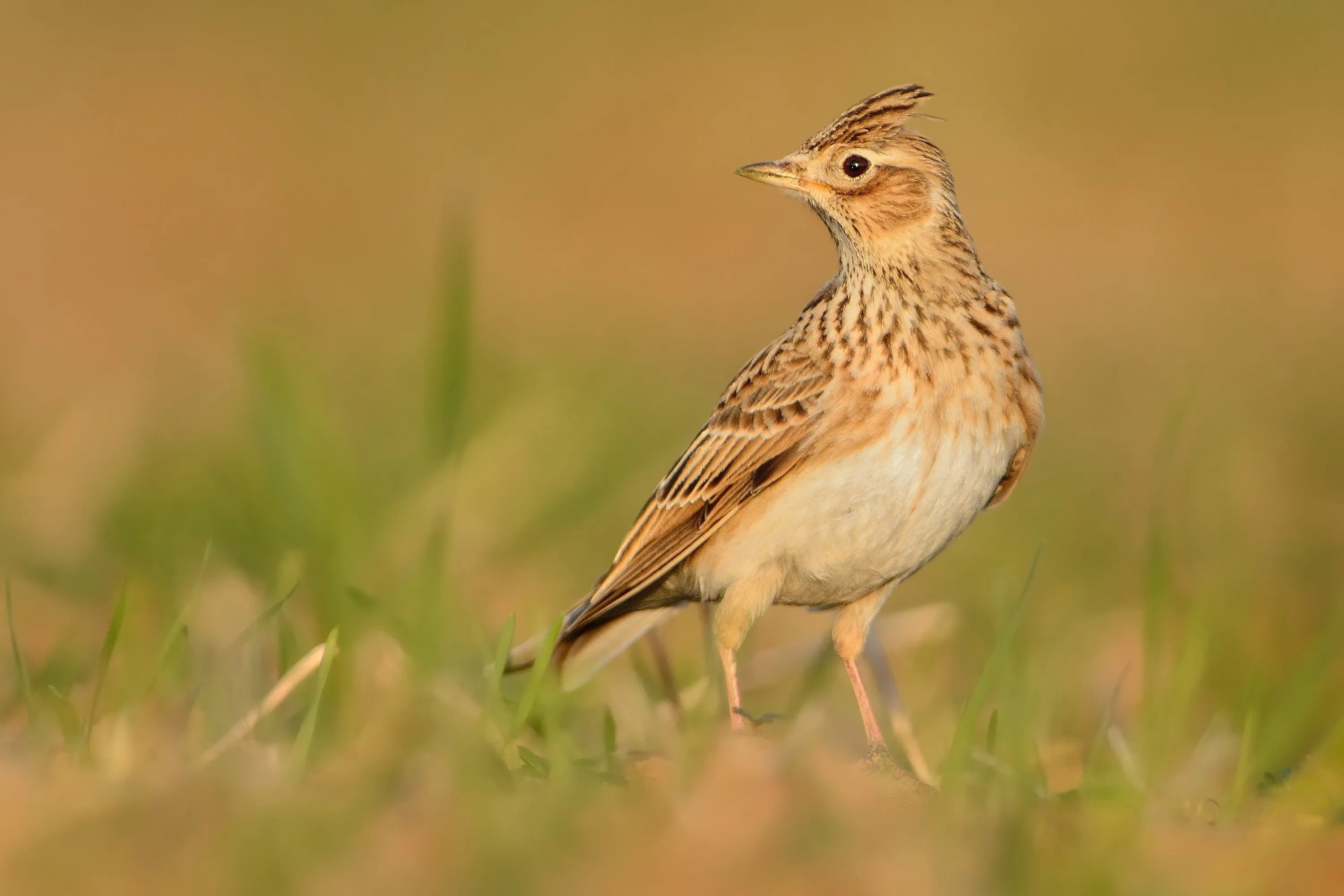
To help ground nesting birds such as Skylarks, please stay on marked paths and avoid any roped-off wildlife areas. Please also keep dogs on a short lead between March and August in areas such as heathland and grasslands, as this will help protect any undetected nests. We also provide advice for farmers on reducing impact to these birds on farmland here.
Meet the expert: Alex Wilkins
Working in the RSPB Wildlife Enquiries Team is really fun as I am always working on my knowledge with interesting queries and projects! I am especially interested in seabirds and their conservation, having previously had the pleasure of working on the RSPB’s Little Tern restoration projects. It’s always great just to get out there and see some birds!
