
Juvenile Robin
With their bright red chests, adult Robins are pretty unmistakeable, but juveniles lack these characteristic red feathers and are speckly brown all over.


With their bright red chests, adult Robins are pretty unmistakeable, but juveniles lack these characteristic red feathers and are speckly brown all over.
Robins are currently listed as Green on the UK List of Birds of Conservation Concern. This means they are of least concern.
Robins are one of only a few birds in the UK that sing throughout the year. Take a walk in the countryside, head to your local park or into your garden and see if you can hear one.

The UK’s favourite bird is a Christmas staple. However, the brightly breasted Robin is actually here year-round. Despite their adorable appearance, these plucky little birds will aggressively defend their territory, especially around the breeding season.
A melodic, high-pitched whistle. Each verse is different, but most follow a similar structure: short (two to four second), gushing phrases – punctuated with abrupt pauses.
All year round, apart from a quieter period when they’re moulting after breeding, during July – August. They’re even notorious nighttime vocalists, with the invention of streetlights increasing the regularity of their after-dark performances.
Robins like to sing from a perch, whether that be a fence post, a tree branch or the handle of your garden spade. They can be seen almost anywhere around the UK, in gardens, parks and cities.

The dawn chorus is the symphony of song performed by birds looking for love, and to defend their patch.
Often the first bird you'll hear in the morning and the last at night, the Robin loves to sing loudly year round. Robins defend their territory through winter, and their song is their weapon of choice to keep rivals at bay. Their alarm call is a loud and urgent ticking sound, letting enemies know "your time's up, buster!"
Robins are famous for following around gardeners, waiting for a spadeful of overturned soil to reveal a bounty of bugs. Their confidence around humans makes them one of our most beloved feathered friends, and their nesting habits are often reflective of how well they’ve adapted to live alongside us.
Robins’ nests have been found in plant pots, car bonnets, in a plane engine and apparently even in a (deceased) human skull! Despite their placid behaviour around people, male Robins are extremely territorial, defending their patch sometimes until death. They’ll lay around four or five eggs and have two or three clutches throughout the spring and summer months.
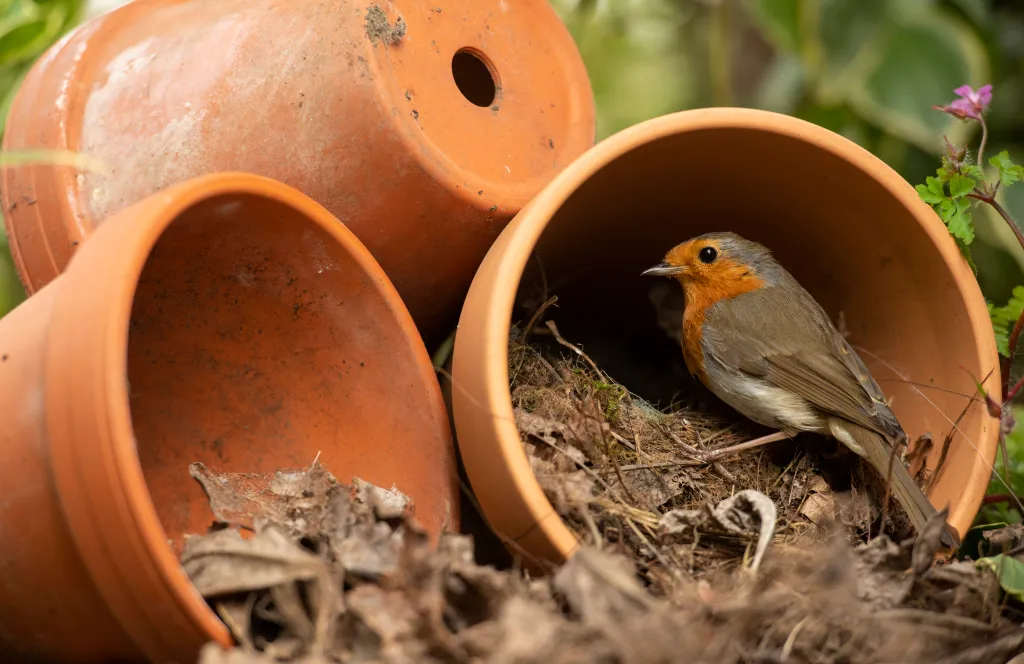
Seen a friendly Robin around the garden? They don't use conventional boxes with a hole. Instead they like what is called an 'open front nestbox' where, instead of a hole, the front is cut in half.
Robins are small birds with an orange-red face and breast, brown upperparts and a pale belly. Males and females have similar colouring. Robins are commonly seen hopping around gardens and woodland.
Male Redstarts can look similar due to their red breast and both Redstart and Robin juveniles will both be a mottled brown in colour.
Robins eat insects, worms, spiders and other small invertebrates. They also eat berries and fruit, and will visit gardens for mealworms and suet.
Robins nest in sheltered places such as holes, sheds, banks, dense vegetation and nest boxes. They often choose sites close to the ground.
Robins usually start nesting in March, although breeding can begin earlier in mild weather. They can raise three broods during the breeding season.
Most Robins live for a few years in the wild, although some can live much longer. The oldest recorded European Robin ringed by BTO (British Trust for Ornithology) was eight.
Most UK Robins are resident birds and do not migrate. However, some Robins from northern Europe migrate to the UK during autumn and winter.
No. Robins are common and widespread across the UK and are one of the country's most familiar garden birds.
UK Robins are present throughout the year. Additional Robins from continental Europe may arrive during autumn and winter.
Most UK Robins stay all year and do not leave. Some continental Robins that winter here return north and east during spring.