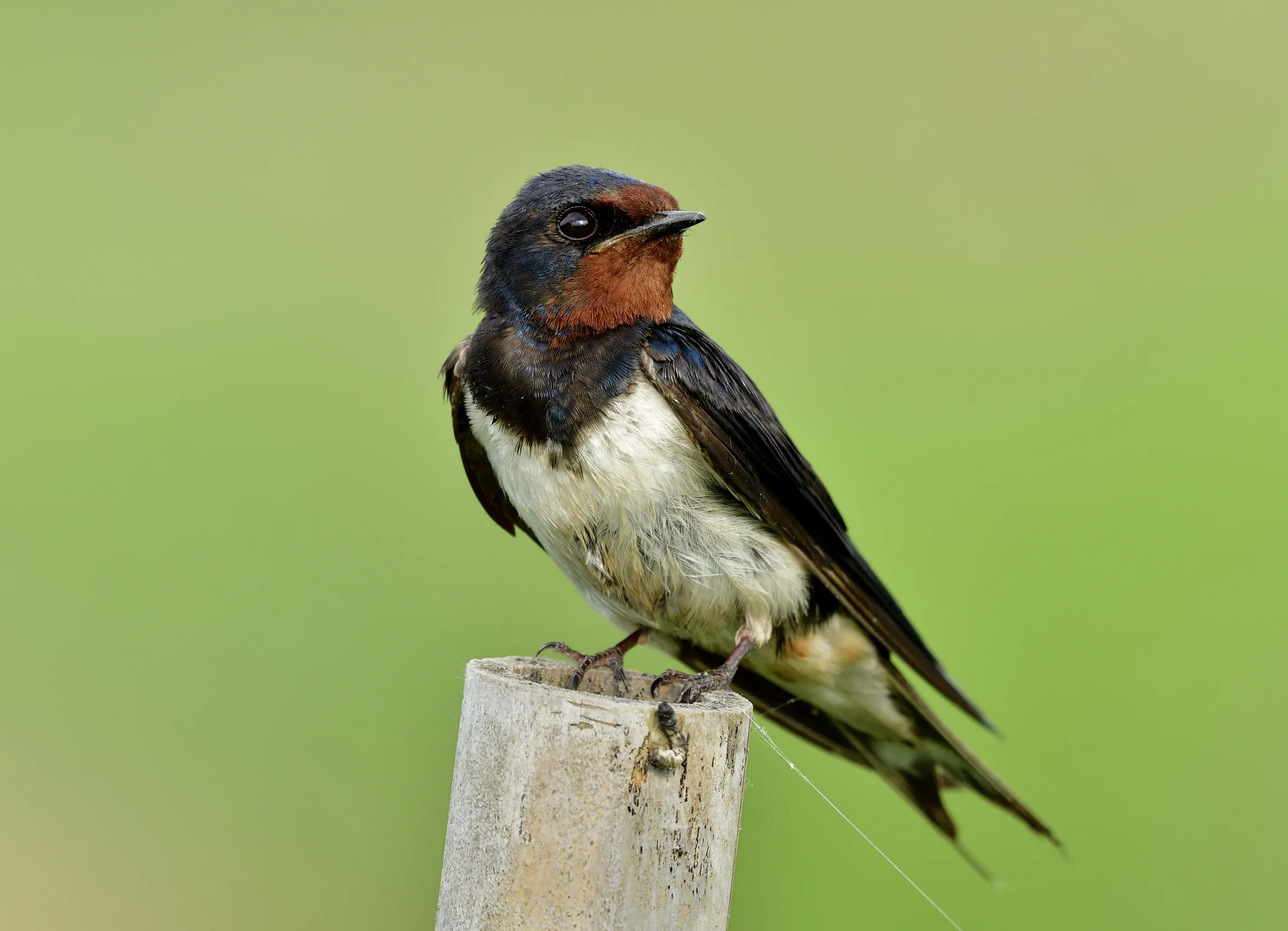
How to identify

Swallows are small birds with dark, glossy-blue backs, red throats, pale underparts and long tail streamers. They are extremely agile in flight and spend most of their time in the air. They are widespread breeding birds in the Northern Hemisphere, migrating south in winter. Swallow numbers in the UK have fluctuated over the last 30 years with strong regional variation in trends.

Call

Swallow

Tomas Belka / xeno-canto

Key features to look out for

  • Glossy blue-black head and back, without the white rump seen on House Martins 
  • Pale, cream underside with a dark band on the chest 
  • Red throat  
  • Distinctive long, forked tail with thin streamers (juveniles don’t have streamers) 
  • Swallows have longer wings than martins 
Swallow perched on rusty barbed wire.
Swallow
Swift, swallow or martin?

Each spring, Swifts, Swallows, House Martins and Sand Martins make one of nature’s most epic journeys, flying all the way from Africa to our shores to breed. At first glance, these avian athletes can look very similar, but there are some key differences between them. Have a read of our handy ID guide and soon you’ll know your Swifts from your Swallows.

Conservation status

They’re on the UK Green List. Swallows are widespread around the Northern Hemisphere. 

When and where to see them

Difficulty rating - Easy

Unlike Swifts, Swallows rarely venture into towns, preferring open countryside where flying insects are plentiful. They can often be seen around open water too. As autumn approaches, large groups of Swallows often congregate on overhead wires and in reedbeds before heading south, back to Africa. 

Key

  1. Resident
  2. Passage
  3. Summer
  4. Winter
* This map is intended as a guide. It shows general distribution rather than detailed, localised populations.
UK distribution map for Swallow
  1. Jan
  2. Feb
  3. Mar
  4. Apr
  5. May
  6. Jun
  7. Jul
  8. Aug
  9. Sep
  10. Oct
  11. Nov
  12. Dec

Behaviour

Swallows are very graceful and acrobatic in flight, darting and gliding low to the ground in search of insects. You might see them skimming over lakes and rivers, scooping up water to drink. 

Did you know?

People used to believe that Swallows hibernated at the bottom of ponds over winter! Now we know that they fly all the way to Africa in autumn, before returning to our shores in spring.  

Migrating Swallows cover more than 200 miles a day, mainly during daylight, at speeds of 17–22 miles per hour!

Call/song

Swallows have twittering, trilling calls which are distinctly different from the screams of Swifts.

Nesting

Swallows like to nest in barns, sheds and other outbuildings. They build their cup-shaped nests from mud, usually on a beam, ledge or joist that’s sheltered from the elements. As the chicks grow, you might see their heads pop up over the rim of the nest to demand food from their parents.  

And tail streamers are quite the talk of Swallow-town – female Swallows prefer to mate with males with longer streamers as it’s believed they will pass on better genes to their offspring! 

A Barn Swallow perched with an insect in its mouth.
Swallow
Birds of the month

Head outside and discover fascinating birds each month. Read on for top ID tips, what to listen for, and where to see them.

Your Swallow questions answered

How can I identify a Swallow?

They are smaller than a Swift with blue-black upperparts, a white belly and a reddish-brown face and throat. The most noticeable feature is their deeply forked tails. They often fly low across fields and sometimes open water. Unlike the House Martin, they don't have a white rump. Look out for them perching on wires, especially late in summer when they are preparing to migrate.

What species look similar?

House Martins, Swifts and Sand Martins can all look very similar to Swallows, however the others do not have a tail as long as the Swallow or a red throat so keep an eye out for these.

What does a Swallow eat?

Swallows eat a range of flying insects which they will catch on the wing. These include aphids, bees, hoverflies and even moth caterillars hanging from trees.

Where do Swallows nest?

Swallows build their nests out of mud in an open cup style within outbuildings, barns and sometimes even porches. They will choose locations close to feeding areas so often in open countryside.

When do Swallows nest?

Swallows nest once they arrive back from migration, mainly between May - September and can have at least two broods.

How long do Swallows live?

They live on average two years however the oldest ringed was 11 years old.

Do Swallows migrate?

Yes, Swallows spend the spring and summer in the UK after wintering in South Africa.

Are Swallows rare in the UK?

They are found throughout the UK but scarcer in the far north of Scotland. Unlike Swifts, they tend to avoid cities and towns, preferring open countryside.

When do Swallows arrive in the UK?

They arrive in April.

When do Swallows leave the UK?

They will gradually leave the UK in September - October arriving in South Africa after six weeks of migration.

Key facts