Priority Species Spotlight: Red-necked Phalarope
Discover this rare wader of the far north and west of Scotland, the wetland habitats it calls home and why this tiny bird needs our help.
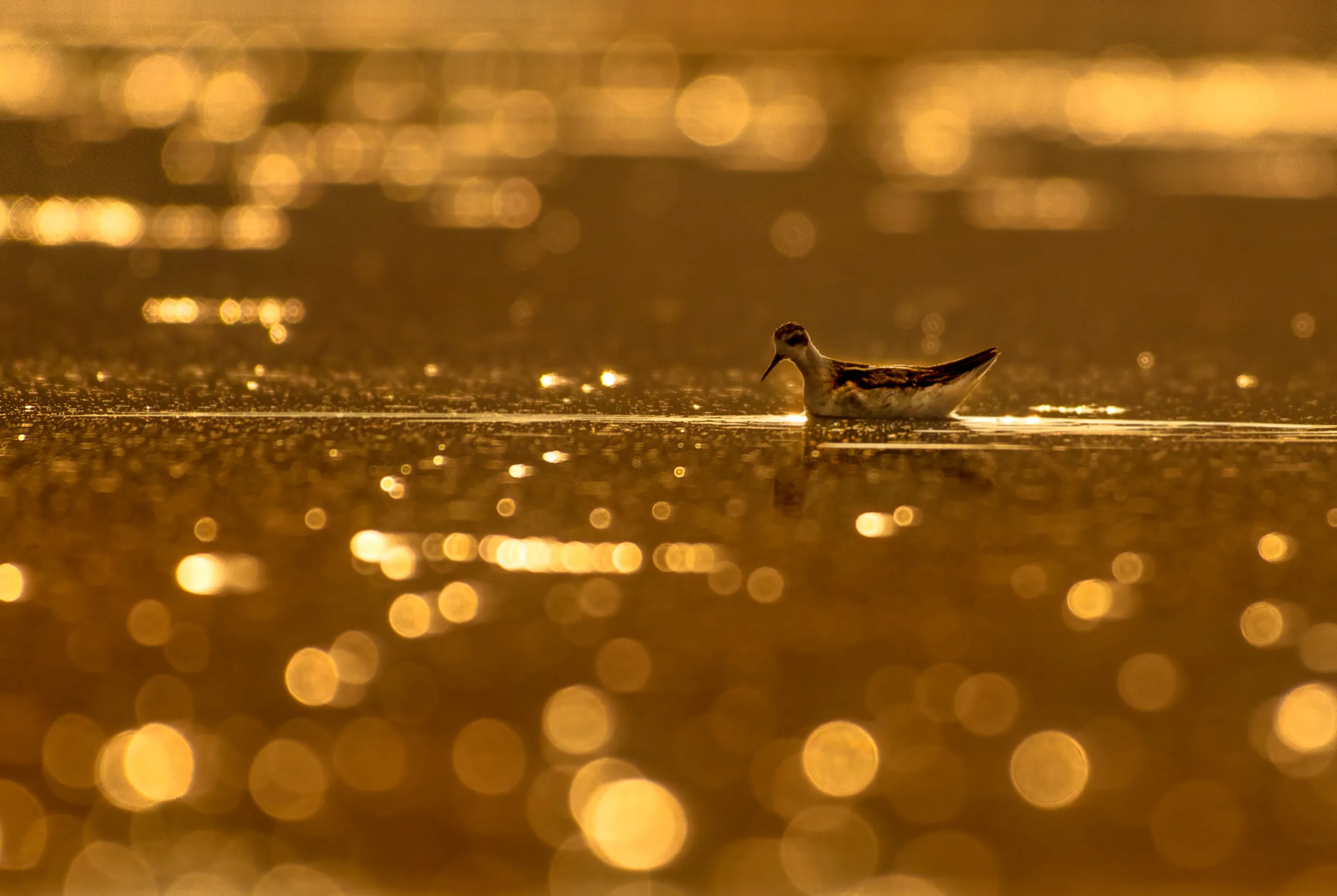
Conservation StatusEndangered (GB IUCN Red List)
UK population statusFluctuating
Main threatsHabitat loss, climate change, disturbance
Get to know the Red-necked Phalarope
Out on the shallow pools of Shetland, something odd is happening. A small, delicate wader spins in tight circles on the water's surface, stirring up a tiny whirlpool of insects to snatch and eat. Nearby, a female watches, brighter and bolder than any male in sight, her neck striped red, her throat a clean white against a slate-grey head. It's she who did the courting here, not him.
In Red-necked Phalaropes, females compete for mates, and once the eggs are laid, they usually leave. It's the duller, quieter male who incubates the nest alone and commonly raises the chicks.
These tiny waders, some of the smallest in the UK, are long-distance voyagers that spend far more of their lives at sea than on land. Their lobed toes let them swim strongly on open water, and once the breeding season ends, they head out to winter offshore, in low-latitude seas rich with the zooplankton they feed on.
In the UK, they're a truly rare sight, breeding only in a handful of places in the far north and west of Scotland, especially Shetland and the Hebrides. Their diet during the breeding season consists mainly of insects.

Did you know?
Red-necked Phalaropes weigh about the same as a golf ball, yet every year they undertake a huge migration. Back in 2012, work to understand more about Red-necked Phalarope migration involved fitting a number of birds in Shetland with tiny geolocators. The following spring, the tag of one male was successfully retrieved and revealed that it had spent the winter in the waters off the Galapagos Islands before returning to Shetland that spring.
Why are Red-necked Phalaropes in trouble?
Red-necked Phalaropes have always been rare in the UK, and their numbers never quite settle into a pattern. Since the 1990s, the count has bounced around, some years bringing real hope, others a worrying dip, and we don't always know why.
Below are some of the factors that could be having an impact on the species, plus there could be as yet unknown factors at work.
Red-necked Phalaropes rely on wetland habitats. They often favour shallow pools with plenty of wetland vegetation around the edges, like old peat cuttings but also use larger waterbodies with similar structure. If pools silt up, dry out, or lose the mix of open water and vegetation they need, through changes in grazing or drainage, the sites can become unsuitable for Red-necked Phalaropes.

Local climatic factors could be playing a part in the fluctuations in their numbers – for instance spells of particularly wet or dry weather could be impacting on the species. In 2024 in particular, Red-necked Phalaropes turned up in Shetland as usual, but many at some sites didn't end up engaging in breeding behaviour or breeding. Fluctuations in numbers have also coincided with periods of El Niño events – as in 2024.
Further research is needed to understand how climatic factors during their migration and on their wintering grounds affect the population too.
Red-necked Phalaropes can often build their nests 50-100 metres from open water, tucked away and easy to miss. Walking through where they are nesting, risks disturbing the birds or even stepping on a nest, or a chick, without ever knowing they were there. This makes it particularly important to not seek out nesting phalaropes, and to only view these magnificent birds from designated viewpoints, and safe spaces.
How is the RSPB helping the Red-necked Phalarope?
Here’s just a few of the ways we’re helping Red-necked Phalaropes.
Reserve management
The UK's Red-necked Phalarope population overlaps closely with our nature reserves, especially in Shetland, which holds around 75% of the UK's breeding birds each year. Through grazing, digger work, and hand-cutting in places machinery can't reach, we manage pools to keep them exactly as Red-necked Phalaropes need them: open water, fringed with the right vegetation for nesting and feeding.
Projects in Fetlar have been focussed on managing habitat for the species. This work has involved removing vegetation, creating pools and removing overgrowth and silt from existing pools as well as removing excavated soil from sites to reduce high areas from the mire habitats. Cattle grazing and trampling over autumn and winter is being used to create a mix of plant heights and densities favoured by Red-necked Phalaropes and other wading birds. RSPB has also carried out habitat creation work, monitoring and advice on sites in Shetland and on the Outer Hebrides through the National Lottery Heritage Funded Species on the Edge Project.
Monitoring
Every year, we coordinate monitoring across RSPB nature reserves and, in Shetland, non-reserve sites too, building a detailed picture of where these birds are breeding and how many there are. That data is shared annually with the Rare Breeding Birds Panel, helping build a national picture of how the species is faring.
Research
We're colour-ringing chicks in Shetland to better understand their lives, from how long they live to where they go, but also how they use sites and habitats. This work has already revealed a Shetland-hatched male later breeding on Tiree, showing a link between two of the UK's most important areas. In addition, resightings show ringed birds returning to breed off our nature reserves, which is ideal, as we want the population to continue to grow beyond the stronghold of managed reserves.

Supporting Red-necked Phalarope in Iceland
Did you know that the RSPB is also working hard for Red-necked Phalaropes outside the UK? In Iceland, together with our partners, we are helping to protect and restore the country’s precious lowland wetlands which are home to thousands of breeding Red-necked Phalaropes every year - as well as Redshanks, Dunlins, Whimbrels and lots of other migratory wading birds.
How can I help Red-necked Phalaropes?
Report your sightings
Reporting your sightings, locally to RSPB staff can help us to identify any new sites that the species might be using. Contact Kevin Kelly.
Safe viewing areas
Red-necked Phalarope and their nests are sensitive to disturbance and highly protected legally, so if you’re keen to see the species, we recommend heading to one of our advertised safe viewing areas. Such as the Mires of Houbie viewpoint in Fetlar.
Learn more about our partners
Red-necked Phalaropes are one of the species supported through Species on the Edge, a partnership working across Scotland's coasts and islands to protect vulnerable wildlife. In Shetland, our reserves team works closely with them to identify new opportunities to help this rare bird.
Become a member
Join the RSPB, and you'll be helping fund conservation work across the UK, including the careful, ongoing management that gives species like Red-necked Phalaropes a fighting chance. You'll get access to over 170 nature reserves, plus a quarterly magazine bringing you the latest from our projects at home and overseas.
Taking species on a journey to recovery
To ensure we can support Red-necked Phalaropes as effectively as possible, we’ve designated them one of our 100 RSPB Priority Species. This means we’re focussing our efforts on researching and helping their populations recover.
1. DiagnosisIdentifying there's a problem, and researching to find out what's causing it
2. Testing solutionsDeveloping practical solutions and trialling them to make sure they work
3. RecoveryProviding these solutions across the whole range of the species
4. Long-term legacyReaching improved conservation status and securing a long-term legacy for the species’ recovery
Testing Solutions
We use the species recovery curve to track our progress and our work for Red-necked Phalarope is at the Testing Solutions stage. On Shetland, we've found a management approach that works, but the population still fluctuates year to year, and there's more to learn about the pressures Red-necked Phalaropes face, from local conditions to what happens on migration. The next step is testing whether the same success can be repeated at other key breeding sites.
Find out more about our work with threatened species by visiting Protecting habitats and species under threat.

Feeling inspired?
Become a member
When you become an RSPB member, you’re joining a flock of nearly 1.2 million nature lovers who are helping to protect our wonderful wildlife and wild places.
Sign up to hear from us
Keen to learn more about wildlife but unsure where to start? Join over 1 million nature lovers and sign up to our Notes on Nature newsletter today!
Make a donation
A donation to the RSPB strengthens our resolve and helps us to work towards a brighter future for nature.
Thank you!
Our work to help Red-necked Phalaropes wouldn't be possible without our Shetland reserves team, whose careful management keeps these birds' breeding pools exactly as they need them, the local landowners we work with and our partners and funders including Species on the Edge, National Lottery Heritage Fund, Scottish Marine Environmental Enhancement Fund, Biodiversity Challenge Fund, Seacology/Highlands and Islands Environment Foundation and the Nature Restoration Fund.
Thank you, above all, to our members and supporters, whose support makes this work possible.