
RSPB Mersehead
There’s so much to explore at Mersehead. We have freshwater pools, woodland, farmland, mudflats and a fabulous beach.
Learn how to identify our native amphibians, and how you can help them.

They may look similar, but there are actually some major differences in how they look, how they move, and what their spawn looks like.
Frogs have smooth, wet-looking skin, whilst toads’ skin is much more rough and warty. Whilst frogs can jump, and have longer legs for this reason, toads have much shorter legs and prefer to crawl.
Both frogs and toads release spawn. Frogspawn is in jelly-like clumps, and toad spawn is released as long strings.
There are two types of native frogs in the UK. These are the Common Frog and the Northern Pool Frog. If you see a frog, it’s most likely to be a Common Frog.
Common Frogs are found throughout the UK, apart from some Scottish islands, and some of the Isles of Scilly and Channel Islands. They’re often found in garden ponds, where they breed in spring.
They come in a variety of colours – they’re usually olive green or brown, but can also be yellow, pink, red, cream of black. Look out for stripes on their hind legs, and a dark mask behind their eyes.


You’re much less likely to see a Northern Pool Frog. They were presumed extinct in the UK in 1995, but have been reintroduced to a site in Norfolk.
Female Pool Frogs are larger than males. They’re brown or green, with dark blotches, and have a cream or yellow stripe down their back. Their calls are loud and have often been described as a duck quacking.


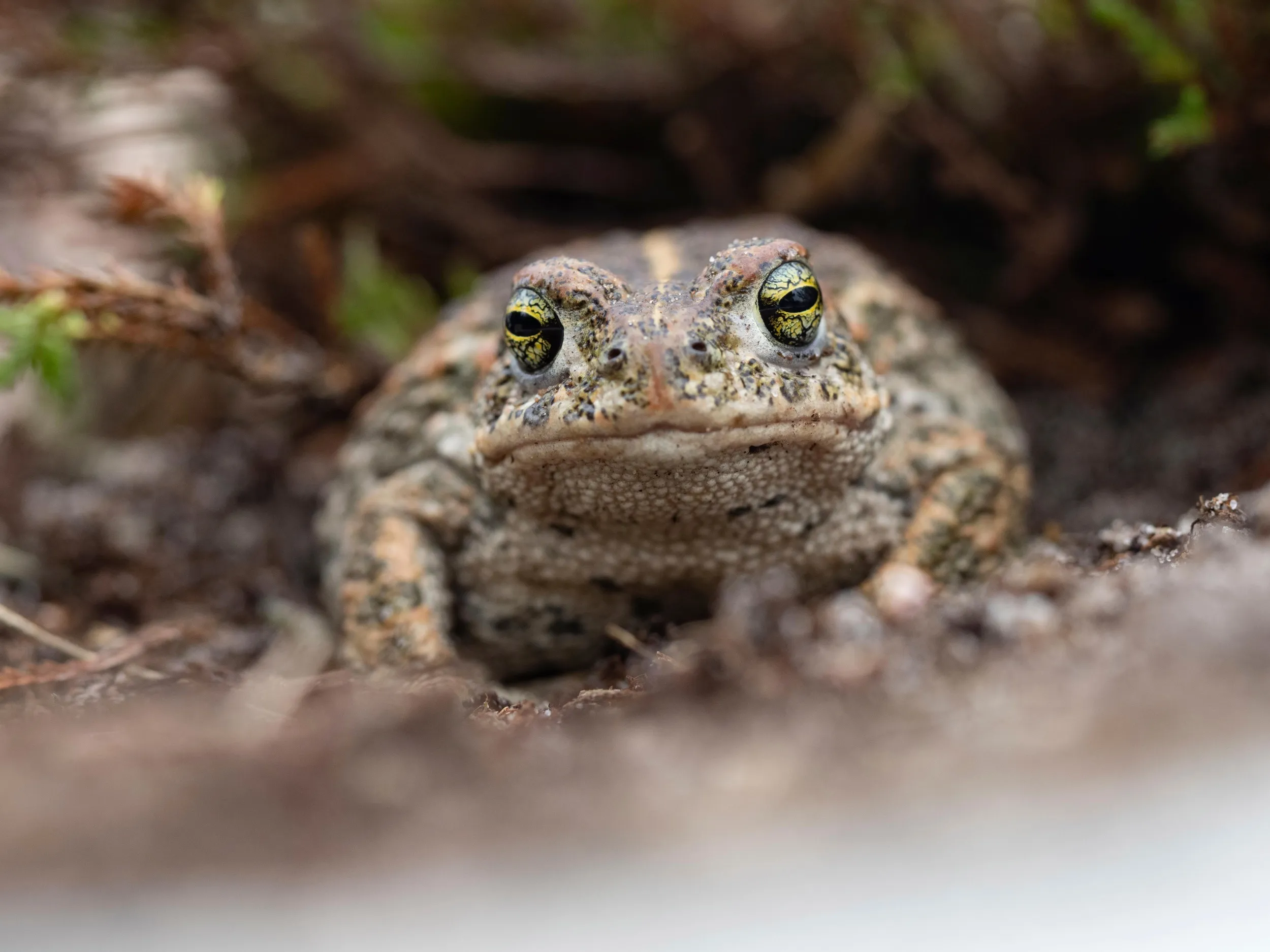
The two UK toad species are the Common Toad and the Natterjack Toad. If you see a toad, it’s most likely to be a Common Toad.
Common Toads generally breed in ponds in the spring. They tend to spend the rest of the year in woodland, gardens and hedgerows. They’re found nearly everywhere, except for the Scottish Islands and Northern Ireland. Common Toads are nocturnal.
Look out for a toad with greenish brown warty skin, and very short back legs.


Natterjack Toads are much rarer than Common Toads, and are only found in a handful of places in England and Scotland. They’re a mainly nocturnal species.
They’re much greener than Common Toads, and have a yellow strip down their backs. They’re also known as ‘running toads’, as unlike Common Toads, they run rather than walk.
Natterjack Toads are a protected species, so we limit access to their breeding sites. In spring, RSPB Mersehead organises Natterjack Nights where you can see them first-hand with a licenced guide.


There’s so much to explore at Mersehead. We have freshwater pools, woodland, farmland, mudflats and a fabulous beach.
Yes! We also have three species of newt. These are the Smooth Newt, Palmate Newt, and Great Crested Newt. Adult newts inhabit ponds during the spring breeding season and into the summer. The juvenile newts develop from larvae, and then leave the pond. Juvenile newts can then be found in woodland, scrub, and gardens.
They’re the newt you’re mostly likely to see. The males have a wavy crest on their head in the breeding season.
Smooth newts can be seen widely across the UK, and they’re often found in garden ponds. They’re absent from the Isle of Man and some Scottish islands.


Palmate Newts are much less likely to be found in garden ponds. Unlike Smooth Newts, they don’t have spots on their throat. During the breeding season, the males develop black webbing on their feet.
Their distribution around the UK is quite localised. They’re absent from Ireland, the Isle of Man and some Scottish islands. They’re also less common in central England than other UK newt species.


The Great Crested Newt is our largest newt. The males have a long, wavy crest during the breeding season. They can grow up to an incredible 15cm in length! In the UK, Great Crested Newts are protected by law.
They can be found across England, mainland Scotland and Wales, but their numbers have declined rapidly in the last 50 years.


Frogs tend to spawn from late January to March, and toads spawn slightly later, from late February to March and early April.

Tadpoles are more difficult to tell apart. Toad tadpoles are rounder and fatter, and stay black throughout their lifecycle.
Frog tadpoles are thinner. They’re initially black, but then become more mottled brown as they get older.


Frogs and toads start their life as spawn. After a few weeks, they emerge as tadpoles. Over the next 14 or so weeks, they slowly change into frogs or toads, a process known as metamorphosis. The tadpoles’ tail shrinks away, skin grows over their gills, and they form lungs. At this point the life cycle is complete.
In early spring, toads return to ancestral breeding ponds along the same route each year. This means they can be at risk when crossing roads. Some toad routes have dedicated ‘toad patrol’ volunteers who keep them safe on their journey.


That’s fine! They often travel considerable distances to find a mate. Just leave them alone – if they came from a pond, they’ll know how to return to it. Common Toads only really go to ponds to breed, so they’ll be fine where they are.
Make sure you keep pets away from frogs and toads if you see on in your garden. Cats can severely injure them, and dogs can get very ill from the toxins in toads’ skin.

Looking at your space, if you were a frog or toad, how easy would it be to make your way around the garden and in and out of it? Find out how could you make access easier here.
If you’ve got the space, you can create a winter home for amphibians. We’ve got all you need to find out what to do.
You can also make a wildlife pond to give them somewhere to breed.
Another way is to attract bugs and other insects to your garden, which frogs, toads, and other wildlife can feed on. Find out how to build a bug hotel to benefit wildlife.

You can view a range of frog and toad habitats at the RSPB shop.


