How one giant windfarm is threatening seabirds and the future of offshore wind in Scotland
We’ve joined forces with other nature charities and written to the First Minister to explain how to unlock offshore wind and protect one of Scotland’s wildlife wonders.

On this page
Imagine you’re a seabird.
Each year you return to the same spot on a Scottish cliff to nest and raise your chicks. But this year something has changed.
An enormous offshore windfarm has been built nearby, in a crucial place where you usually find fish. The windfarm is four times the size of the closest city, with hundreds of turbines taller than skyscrapers.
You have a choice. You could risk crashing into the turbines to find the food you and your chicks need. Or you could avoid the windfarm, travelling miles out of your way to search for fish which are scarcer than they used to be. This journey will be long and exhausting, facing the elements – it could take days. If you do survive, you could be back too late to feed your chicks.
This is the heartbreaking situation seabirds would have to face if a mega windfarm called Berwick Bank is approved.
But it doesn’t have to be this way.
We can unlock a future where Scotland’s already struggling seabirds are helped to recover, while producing the renewable energy needed to help fight climate change.
If Berwick Bank is refused, the devastating impacts on thousands of seabirds can be avoided.
If Berwick Bank is refused, it will open the door to a host of less damaging offshore wind opportunities. Let us explain why.
The problem
Berwick Bank is a gigantic windfarm. To put it in perspective, it would take up an area four times the size of Edinburgh with more than 300 turbines – each the height of six Scott Monuments.
But it’s not just the size of this windfarm that is the problem. It’s the proposed site, off the East Lothian coast, next to some of the most important places on Earth for seabirds.
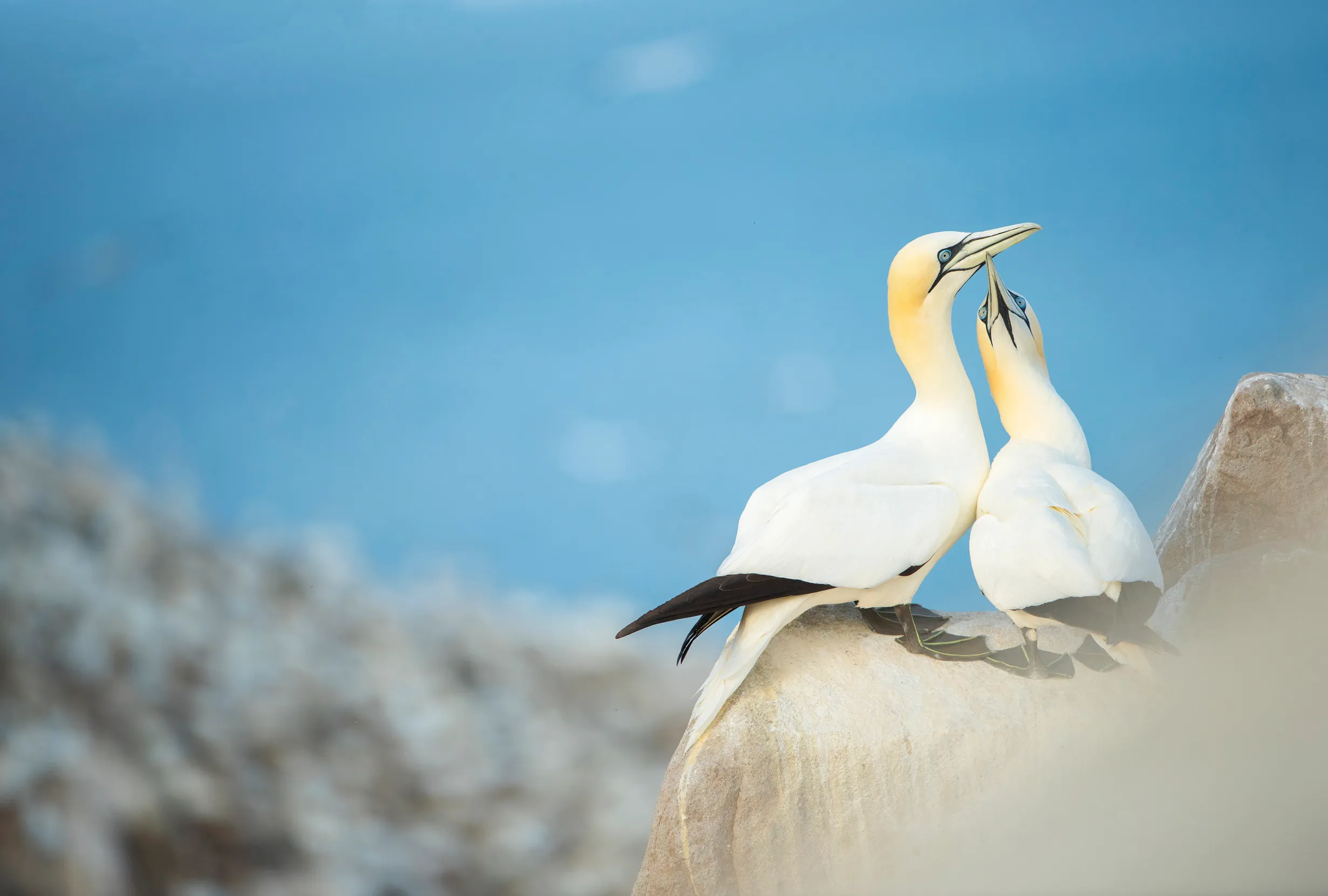
It’s here you’ll find the Bass Rock, home to the biggest colony of Northern Gannets on the planet, and the Isle of May, a haven for Puffins.
Berwick Bank is proposed to take over a large area near these key seabird breeding and foraging areas.
It is predicted to kill tens of thousands of seabirds and tens of thousands more would lose their vital feeding areas.
This comes as Scotland’s seabirds are already in crisis. Around 70% of species are in decline, with threats including unsustainable fishing practices, climate change, and invasive species. Much-loved species like Puffins are facing national extinction this century.
How Berwick Bank is blocking less damaging new offshore wind projects
RSPB Scotland firmly believes expanding offshore wind will be an essential part of our efforts to fight climate change in Scotland and beyond.
However, shallow, relatively near shore developments like Berwick Bank are unsuitable because of the huge impact on Scotland’s globally important seabirds. Floating wind technology, which can be deployed in deeper water sites further offshore, has a much lower risk to seabirds who prefer to feed as close to their nests as possible.
The great news is that floating offshore wind sites are now here. Multiple sites are being progressed right now. And now that we can see the detail of these modern floating proposals, it has confirmed that these sites are likely to be of much lower risk to seabirds than Berwick Bank – the site for which now dates back over 15 years.
As an illustration of just how much less damaging floating wind could be, developers submitted a proposal for a floating offshore windfarm called Ossian to the Scottish Government last year.
Ossian would be just a little further offshore than Berwick Bank, in the same general area of the North Sea. It would generate almost as much electricity as Berwick Bank (3.6GW v 4.1GW). But, while it would still have some impacts, Ossian would not be as devastating as Berwick Bank.
For example, Ossian and other windfarms are estimated to reduce the Kittiwake population of St Abb’s Head alone by up to 13%. This is a worryingly large number, and significant work would be needed to help populations recover.
But add in Berwick Bank and the two projects together would completely devastate the population at St Abb’s by a shocking 81%! That could fast track Kittiwakes towards extinction. And that is just the worst impacted species - many other species would also be harmed by Berwick Bank at many other seabird sites around Scotland's coastline.
The impacts of different wind farms (rightly) need to be considered together. So, if Berwick Bank goes ahead there is a very reduced chance Ossian could be allowed to proceed due to these substantial combined impacts.
In fact, if Berwick Bank were green lit, its devastating impacts would have to be added to those of every other less damaging project coming forward in future. Frustratingly, this would make it much more difficult for them to proceed even though they may be much less damaging than Berwick Bank.
What we’re doing about it
RSPB Scotland joined forces with the Marine Conservation Society, National Trust for Scotland, Scottish Seabird Centre and Scottish Wildlife Trust.
Together, we wrote to the First Minister urging him to unlock nature positive offshore wind by refusing Berwick Bank and investing substantially in measures to help our already beleaguered seabirds.
On May 16, we received a reply from Deputy FM Kate Forbes, who said “full consideration” will be given to the objection by Scottish Ministers.
We’ll be seeking a meeting to discuss this further with Ministers.
Meanwhile, if you want to join us speaking out against this proposal, you can add your voice to this action by the Scottish Seabird Centre.
What you can do about it
- If you feel strongly about this issue, you can write to your MSPs about it. You can find your MSPs and email them easily on writetothem.com.
- You can also email Scottish Ministers directly at scottish.ministers@gov.scot.
- For the latest updates, be sure to sign up to our campaigns newsletter - don’t forget to select “opt in” for emails.