
Dawn Chorus Day
Head to our Dawn Chorus page to discover all you need to know to tune into the Dawn Chorus.
May is the month the skies fill up again. Here are our five favourite things to listen and look out for.
.jpg)
May belongs to the summer migrants. All winter, our skies and woodlands have been waiting. Now, one by one, the summer visitors are back - and they've brought their voices with them. House Martins are swooping over the rooftops, Nightingales are filling the dark with song, and somewhere above you, screaming like they own the sky, Swifts are making up for lost time. May is also when the dawn chorus hits its peak, so here are our top five sights and songs to let soar over you this month.
From March through to June, birds across the UK sing with a passion that has to be heard to be believed. Not one voice but dozens, each one different, weaving together into something that feels less like background noise and more like a perfectly orchestrated concert.
Early May is when every singer has found their voice. That’s why every year on the first Sunday in May, alarm clocks go off, kettles boil before the sun is up, people pull on coats over their pyjamas and step outside, or simply lie still with a window open, and listen. This year, that’s Sunday 3 May, celebrated by people who've decided this is a sound worth getting out of bed for.
Whether you go looking for it in nature, catch it as you go about your day, join one of our Dawn Chorus events at a local RSPB nature reserve or simply let it come to you, we want you to experience nature's choir. Record the joy of birdsong, share your dawn and tag #DawnChorusClub, challenging someone else to get up and let the dawn chorus soar over them too.
Head to our Dawn Chorus page to discover all you need to know to tune into the Dawn Chorus.
Everywhere, from city streets to woodland at first light. Join one of our guided Dawn Chorus walks at a local RSPB nature reserve to hear it with an expert guide who can put names to every voice filling the air around you.
From just before sunrise, when the air is still and every sound carries.
Easy. You don't even need to leave the house. Open a window, close your eyes and let it in.
The dawn chorus is one of nature's greatest sounds, but for many species that sing in it, numbers are falling. By celebrating International Dawn Chorus Day and sharing what you hear, you're helping raise awareness of the birds that need our help most. You can also support our work to protect them by becoming an RSPB member.
Look out for a flash of blue-black and brilliant white skimming low over the rooftops. That's the House Martins, back from Africa and wasting no time making themselves at home again. These plump little birds arrive in April and May and get straight to work on what might be nature's most impressive DIY project. Each mud nest is built pellet by pellet under the eaves of buildings, with around a thousand beak-sized mouthfuls of mud going into every one. If you discover an old nest on your house, leave it be, as House Martins often come back to the same nest year after year, saving themselves weeks of labour.
They nest in colonies, sometimes with several nests built side-by-side under the same eaves, and are most active in the morning and evening, swooping low over water where the insects are. That white rump is the easiest way to pick them out as they zip past.


A rapid, cheerful chattering call as they swoop past.

Towns, villages and anywhere near water where there are plenty of flying insects to be found.
Easy. Look up and listen for that chattering call.
House Martins have declined in recent decades and are now on the Red List of Birds of Conservation Concern. Leave existing nests in place and you can give even more somewhere to call home by putting up an artificial House Martin nest box.

Browse House Martin nest cups on the RSPB shop.
Sand Martins are the early birds of the martin family, often reaching the UK as early as March. By May they're well settled, nesting in noisy, sociable colonies in sandy riverbanks, cliffs and gravel pits. Unlike their House Martin cousins, who build mud nests under eaves, Sand Martins dig their own burrows into the bank face. They're the smallest of the European hirundines (the collective name for martins and swallows) and the easiest way to tell them apart from House Martins is that band of brown across their chest.
Watch for them swirling and flapping, rather than gliding, fast and low over water on flickering wings, snapping up insects without breaking stride.


A harsh, dry rattling call, quite different from the cheerful chatter of a House Martin.
Near rivers, lakes, gravel pits and reservoirs. Look for colonies nesting in sandy or earthy banks.
Moderate. Once you find a colony they're easy to watch, but you need to know where to look.
Sand Martins are Green-listed in the UK, though it hasn't always been that way. Twice in the past 50 years, drought in their African wintering grounds has caused their populations to crash, and they've had to fight their way back both times.
Don't let the appearance fool you, while Nightingales may look like plain, unassuming little brown birds, about the size of Robins, all you need to do is open your ears and everything changes. Easily overlooked in the dense thickets they call home, the Nightingale’s beautiful call is a wonder of sound - a complex and impossibly varied melody, filled with a fast cascade of high, low and rich notes that stops you in your tracks.
May is the best time to hear one. Find a patch of dense scrub or woodland in southern England, stand very still, and wait. They’re far more likely to be heard than seen - but that song, once heard, is impossible to forget.
.jpg)
.jpg)
.jpg)
Rich, loud and endlessly varied song, often heard after dark. One of the most mesmerising voices of the natural world.
Nightingales can be tricky to spot, but your best chance of experiencing their song is in the woodland and scrub of southern and eastern England, mainly south of the Severn-Wash line.
A challenge. Secretive, local and found mainly in the south and east, but worth every effort.
Nightingales are on the Red List of Birds of Conservation Concern. There are only around 6,700 breeding males left in the UK, which is why finding one feels so special.
When you hear that piercing call overhead, you'll know summer has arrived; the Swifts are back. Swifts zoom across our skies from late April, but May is when they really make themselves known, racing in shrieking gangs through the warm air above our rooftops. Rarely touching the ground, everything they do happens on the wing - eating, drinking, sleeping, even mating, all of it airborne. The only time Swifts leave the sky is to nest.
Long before Taylor Swift had Swifties, these birds had their own devoted following as they travelled on their own epic world tour. One of nature's greatest long-distance athletes, every year Swifts make one of the longest and most impressive migration journeys in the world to get here – flying around 22,000 km to reach our shores, and they can clock up around two million miles in the air over a lifetime.


That high-pitched scream, one of the most evocative sounds of a British summer.
Over towns and cities across the UK from May onwards, particularly around old buildings where they nest.
Easy. Look and listen over rooftops on warm evenings.
Swifts are on the Red List and their numbers are falling fast. For every ten Swifts sailing across our skies in 1995, only about three were left by 2022. You can help by putting up a Swift nest box on your home, or by recording nesting Swifts near you using the RSPB's Swift Mapper tool - every sighting helps us understand where they need our help most.
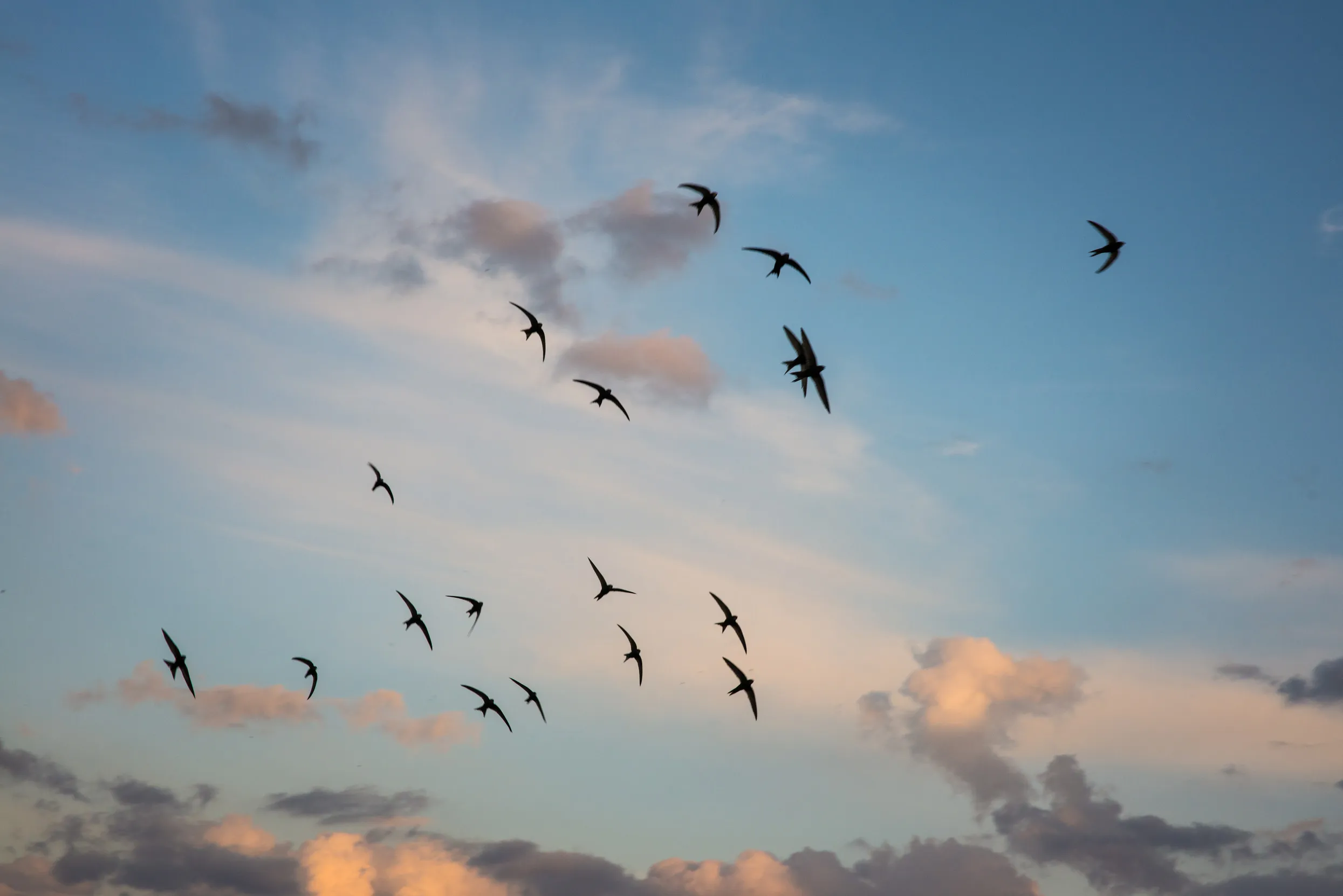
We’re taking action to help Swifts. We need your help to look out for nesting or screaming Swifts near you so we can identify nest sites that need protection
We hope you feel inspired to get out and listen this month. We'd love to hear what you experience this May. You can share your photos with us at NotesonNature@rspb.org.uk. We'll share some of the best in a future issue of Notes on Nature. And if you're joining us for International Dawn Chorus Day on Sunday 3 May, record the joy of birdsong, share your dawn and tag #DawnChorusClub.


