Stone-curlews under cover: an on-the-ground mission backed by members
From restoring grasslands to monitoring nests, our members’ support brings species back from the brink.

On this page
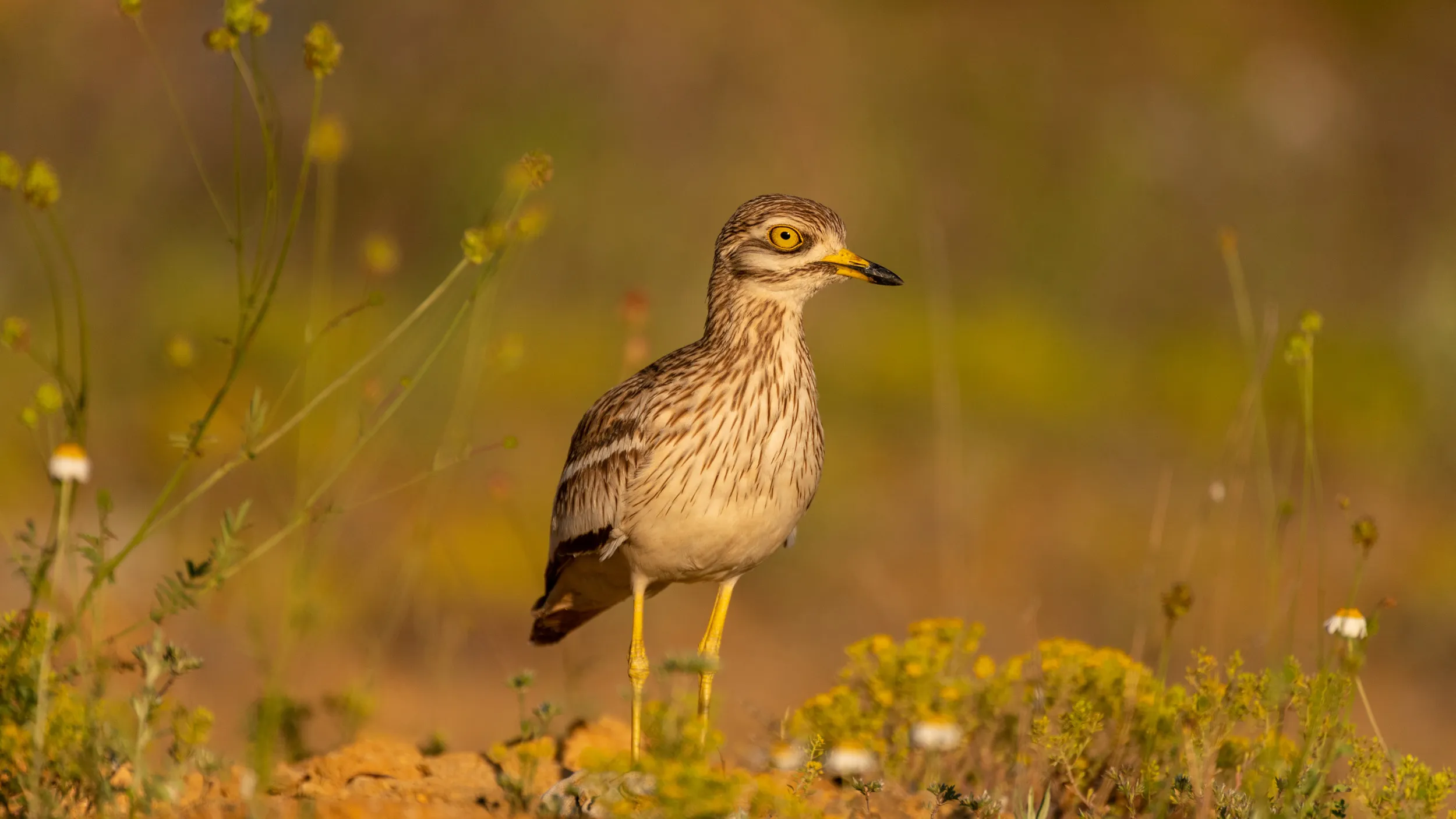
Did you know that, while both wading birds, Stone-curlews are actually in a different family to the Curlew? The Stone-curlew gets its name from its distinctive, ‘kuu-liie’ call, but is actually a member of the thick-knee family. These birds need dry places to nest where their camouflaged plumage makes them a master of disguise.
Earlier this year, we celebrated the 40th anniversary of the Stone-curlew Project which, along with the efforts of our conservation partners, was responsible for doubling the numbers of these vulnerable birds in the UK.
These sorts of recoveries just wouldn’t be possible without RSPB members. Their support means our teams can work in partnership with farmers and landowners to monitor nests and it also enables us to buy and manage our nature reserves. Together, we campaign to change policy and to secure funding, just like the nature-friendly farming budget which was maintained in the Comprehensive Spending Review earlier this year – a vital lifeline for many of our farmland birds.
Here’s how we’re working together to bring Stone-curlews back from the brink…
Bringing a species back
"They’re a rare bird, and it’s a privilege to be able to see them up close like we do. Particularly when it’s a species that’s so elusive and hard to see,” says Tim Cowan, Conservation Officer for the Brecks. This is Stone-curlew country, where the sandy soils are prime habitat for these stealthy ground nesters.
Traditionally a bird of our rich chalk grassland and grass heathlands, these habitats have seen long-term declines, and instead today’s Stone-curlew populations are now mostly found on farmland in East Anglia and Wessex through spring and summer.
“I remember seeing my first Stone-curlews. Like many other people, I’d made the pilgrimage to go and see them at Weeting Heath, owned by the Norfolk Wildlife Trust. Back then, it was really the only place you could see them from a hide. I was excited to see them but was a bit unlucky that day as they were just distant blobs in the heat haze. I didn’t know then, of course, I’d be looking at them a lot more closely as part of my job in the future.”
For the past 23 years, Tim has been working as part of the RSPB Eastern England Stone-curlew Project, in partnership with Natural England – one of two projects instrumental in this species’ recovery. In 2024, there were approximately 222 pairs in Eastern England (including estimates for un-monitored sites).
Working in partnership
With its buff plumage, the Stone-curlew’s yellow, saucer-like eyes are what distinguish this living creature from its sandy surroundings. These birds stay still for most of the day to avoid attracting the attention of predators and hunt under the cover of darkness. However, this secretive behaviour brings other risks.
Just inconspicuous dents in the ground where one or two eggs are laid, their nests are difficult to find, even for the most experienced conservationists – so they’re easily at risk from ongoing farming operations.
“That’s through no fault of the farmers. Stone-curlew eggs and their chicks are extremely well camouflaged and hard to spot! Now, once we find a nest with eggs, we can tell a farmer where it is so they can avoid it.”
– Tim Cowan, Conservation Officer for the Brecks
Working closely with East Anglian farmers and landowners, Tim’s team of dedicated volunteers spend hours scanning arable fields for potential nests. And their job doesn’t end there. When the eggs hatch, the vulnerable chicks are immediately mobile. Although they will generally stay close to the adults, they could move anywhere on the nesting field or nearby fields. After hatching, farmers are no longer able to avoid a designated nesting area. But Tim’s team can help.

Up close and personal
“What we may have to do is go out and catch the chicks and hold on to them while the farming operation is taking place. I might spend two or three hours sat in a field, with a couple of Stone-curlew chicks in my lap, waiting for a farming operation to have moved far enough away that I’m happy to put them down and think they’ll be safe.”
Tim has trained extensively to be qualified and licensed to disturb and handle these birds. And while this approach might offer some incredible encounters for those with the correct training, it’s labour-intensive conservation and not sustainable for an expanding population in the long term.
“The other side of our work is advocating for more of their natural grass heathland habitat to be created. There are some organisations that do that, and the RSPB have sites that are managed specifically for Stone-curlews.”
A vital lifeline
Over 150 miles southwest, the Wessex Stone-curlew team’s efforts run in tandem with the Eastern England project. Breeding pairs of Wessex Stone-curlews have increased from around 30 in 1985 to approximately 120 confirmed breeding pairs today – this includes estimates for un-monitored sites.
In 2024, 70% of all confirmed Stone-curlew breeding attempts in Wessex were on specially created nesting plots funded through government agri-environment schemes. And 90% of all the young fledged last year were from areas of these specially created nesting plots. This demonstrates just how crucial the nature-friendly farming budget is to nature’s recovery. In May, we handed in our petition to Downing Street – and it was signed by 100,000 members and supporters like you. We were delighted that the Government listened, and the nature-friendly farming budget was maintained.

Safe havens for Stone-curlews
Earlier this year, we were also thrilled to announce a new nature reserve dedicated to making more Stone-curlew habitat – all made possible thanks to our members, people like you.
Formerly an intensive dairy farm, RSPB Roundbarrow nature reserve, owned by Wiltshire Council, is being restored to rare chalk grassland. The RSPB won a competitive bidding process earlier in the year, and we were keen to transform this site into this important wildlife habitat and expand the population of Stone-curlews at the nearby RSPB Winterbourne Downs. Today, you can visit Winterbourne Downs and see former crop fields transformed into chalk grasslands - the perfect habitat to nurture thriving Stone-curlew populations.

Chalkland cornucopia
It's not just Stone-curlews that are set to benefit from Roundbarrow. Soon, this Wiltshire green space will be alive with the songs of Skylarks, Corn Buntings and Yellowhammers.
The rich array of plants found in chalk grasslands – Sheep’s Fescue, oat grasses, scabiouses, vetches, orchids and bellflowers – will help butterflies like the Marsh Fritillary and Chalkhill Blue to thrive. And as a lower number of beef cattle and sheep graze the land, the River Dun, a chalk river which runs below the new nature reserve, won’t be impacted as heavily by nitrogen runoff, a damaging side effect of livestock manure.
The local community will also benefit from increased access to nature, as a new permissive bridleway through the nature reserve will connect two local villages.
.jpg)

Together, we’re helping nature to thrive
Wiltshire is home to roughly half of the UK’s chalk grassland – and these small remaining pockets are internationally important, as this habitat is incredibly rare across the globe. We’ve lost 80% of these grasslands, and the species they support have faced severe declines. Securing the management of Roundbarrow nature reserve was a vital step to help their recovery.
Our members’ support has helped us to get our hands dirty on our reserves for over 100 years – and during that time, we’ve developed tried and tested methods to restore our wild places, where nature and people can both thrive. Now, thanks to that valued support, we’ve been trusted to take care of Wiltshire Council’s important landscape.
Without supporters like you, Stone-curlew populations would have continued to decline over the past 40 years. Through championing nature-friendly farming and funding valuable on-the-ground conservation, there’s a future for these secretive, but extremely charismatic birds.