
Discover more
Learn more about Whooper Swans and where to see them.
Six winter birds worth braving the cold for this January.

January can feel quiet outdoors but head to the woods or a wetland for some top birdwatching moments. At this time of year some of our wetlands are graced with the presence of migrant swans, flown here from far colder climes. Or head to a woodland and listen out for nature’s drummers and some early singers!
If you’re looking for something to brighten up a winter’s day, feast your eyes on the gleaming white beauty of a Whooper Swan. These elegant birds are winter migrants that fly from their breeding grounds in the far north to enjoy the relatively warmer UK winters.
The vast majority come from Iceland, with the UK the winter home for most of the country’s breeding population of Whooper Swans, around 20,000 birds. Smaller numbers also visit from Scandinavia.
Whoopers Swans gather in wetlands, mainly in Ireland, Scotland, northern England and East Anglia, where they roost on open water. During the day, they graze in fields often eating leftover crops such as potatoes and grain, and in lakes and other water bodies feeding on aquatic plants.
These big birds are real high-flyers, able to soar at up to 8,000 metres (26,250 feet) – that’s almost six times the height of Ben Nevis.
Whooper Swans are named for their raucous, trumpeting "whoop-whoop" calls and yelps. They call in flight as well as when they are claiming territory.

Hold their necks straight – Mute Swans tend to arch their necks
More pointed bill than a Mute Swan
Yellow on bill that is wedge shaped
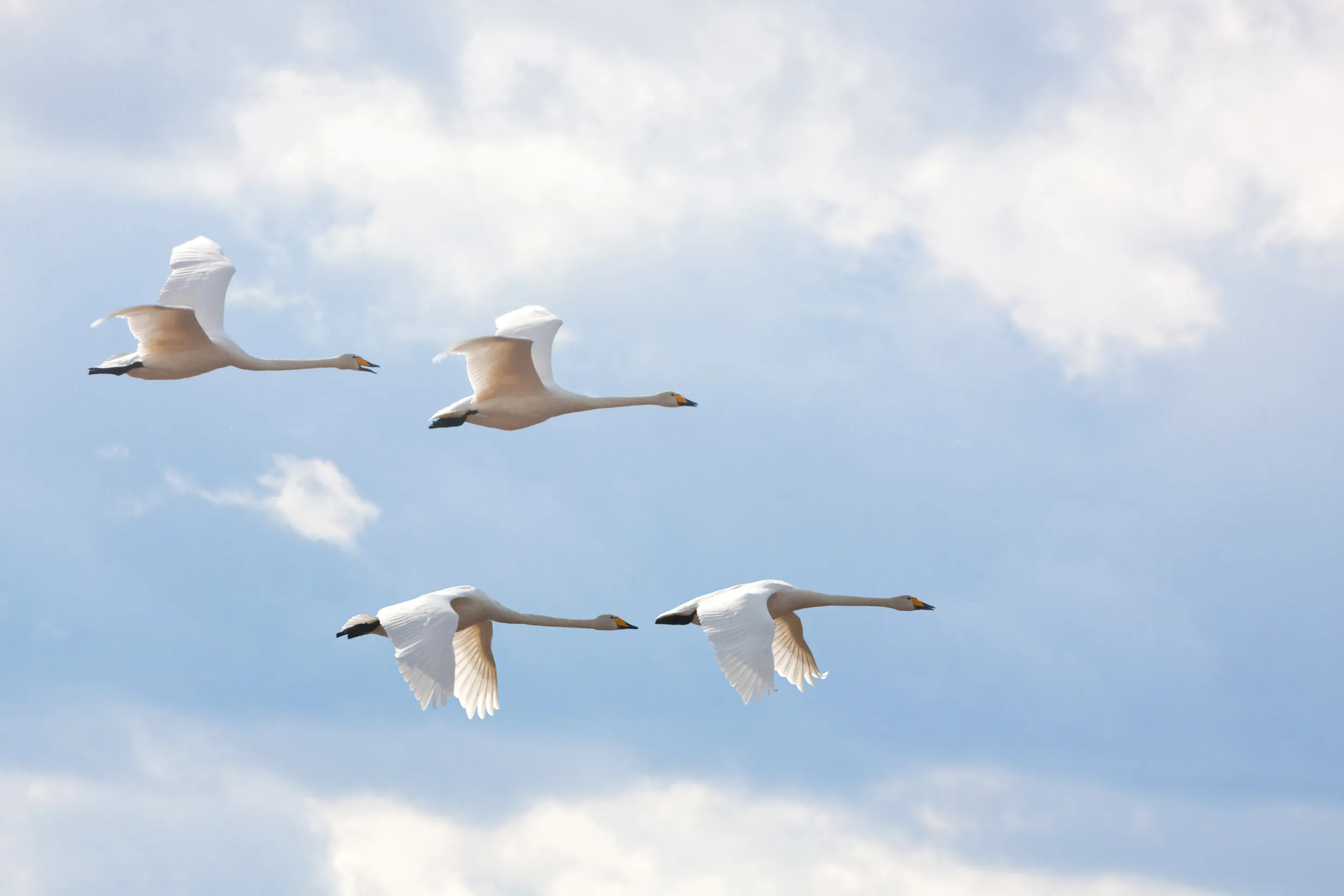


Whooper Swans can be seen in winter in much of Scotland and there are also some large populations further south in England. RSPB sites include Loch Leven in Scotland, Ouse Washes in Cambridgeshire, and Lough Foyle and Portmore Lough in Northern Ireland. Wintering Whooper Swans can also be seen at WWT Welney in Norfolk and WWT Martin Mere in Lancashire.
This winter, around 6,500 Whooper Swans arrived at RSPB Ouse Washes. Senior Site Manager Jonathan Taylor said: “Looking out at the sheer number of Whooper Swans as the sun rises on RSPB Ouse Washes is a true winter wonder.
"It is Cambridgeshire’s biggest wildlife spectacle but not many people outside of our regular visitors are aware of the mass migration of swans to our free to visit site, and especially the current dawn gathering as they take flight to seek out food.”
Moderate. As Whooper Swans gather in fairly large numbers, they aren’t difficult to see as long as you go to the right places at the right time! Head to a site known to have Whooper Swans and ask fellow birdwatchers or reserve staff for where to find them.
Whooper Swans are on the Amber List on the UK's Birds of Conservation Concern. Although there is some evidence that the numbers wintering in the UK are going up due to an increase in the Icelandic population, they face ongoing threats from avian flu and habitat loss.
Learn more about Whooper Swans and where to see them.
Bewick’s Swans are the smallest species of swan that you can see in the UK. Not much bigger than a Canada Goose, these are also our rarest, with numbers dropping sharply over recent years. Recent evidence from WWT, the charity for wetlands and wildlife, suggests that Britain could have lost up to 43% of its population of Bewick’s Swans in just five years.
The swans migrate here for the winter from their breeding grounds on the Arctic tundra in Siberia. But large numbers are now ‘short-stopping’, choosing to spend the winter months in wetlands in central Europe rather that flying to the UK. Climate change means the birds don’t need to fly as far to find ice-free wetlands so they are wintering in Denmark, Germany and the Netherlands rather than the UK.
The yellow markings on a Bewick's Swan's bill are unique to each bird. Because of this WWT have been able to monitor Bewick’s Swans returning to Slimbridge in Gloucestershire for more than 60 years – one of the longest running studies of a single species ever!
Like Whooper Swans, Bewick’s Swans are very vocal and call to other in flight. Listen for a bugling call which some describe as having musical notes!

Smaller than a Mute Swan or Whooper Swan
Hold their necks straight – Mute Swans tend to arch their necks
More pointed bill than a Mute Swan
Yellow on bill is rounded rather than wedge shaped


Bewick's Swans are found mainly in eastern England and around the Severn Estuary. RSPB Ouse and Nene Washes in Cambridgeshire and WWT Slimbridge in Gloucestershire are good places to see Bewick's Swans.
Moderate to hard. These birds are found in only a few wetland sites in winter.
Bewick’s Swans were added to the Red List of UK Birds of Conservation Concern in 2021. Pressures include illegal hunting abroad, ingestion of lead ammunition, and the impacts of climate change and habitat loss.
In 2025, the UK Government has announced new restrictions on the use of lead in ammunition, following campaigning by the RSPB, WWT and other conservation organisations.

Learn more about Bewick’s Swans and where to see them.
A Great Spotted Woodpecker is a little reminder that winter isn’t as quiet as it seems. Its bold black, white and red plumage stands out beautifully against bare branches, and its early season drumming carries clearly through the trees.
When they appear, they often move in strong, deliberate hops around the trunk, pausing to check crevices for food. Many visit garden feeders in winter too, so you might find yourself face to face with one without leaving home. Their lively movements and bright colours bring a welcome spark of life to cold, still days.
Listen for a rapid burst of drumming that lasts for about a second and can be heard some distance away. Their sharp ‘tchick’ call is another good clue, especially in woodland or when they fly into a garden.


Great Spotted Woodpeckers are found in larger woods, gardens and parks across most of the UK. They’ve spread north in recent years and now can be found across England, Wales, Scotland and parts of Northern Ireland. In winter, watch tree trunks and thicker branches carefully, or keep an eye on peanut and suet feeders where they’re often bold, regular visitors.
Easy to moderate. In many areas Great Spotted Woodpeckers are now a regular sight, and their loud calls and drumming give them away. In places with less mature trees, they can be harder to spot, but a visit to a woodland reserve or a garden with good feeders should give you a fair chance of seeing one.
Great Spotted Woodpeckers are on the Green List of Birds of Conservation Concern, with a large and increasing UK population. Good woodland management and deadwood for feeding and drumming both help them thrive.

Learn more about how to identify Great Spotted Woodpeckers, and find out which RSPB reserves are best to see them.
The Lesser Spotted Woodpecker is the kind of bird that most people walk past without ever realising it's there. It’s tiny, smaller than a House Sparrow, and spends much of its time high in the canopy, moving lightly along the finer branches. Sadly, it’s also a difficult bird to see as they have suffered rapid declines since the 1980s. But winter brings your best chance. With the leaves gone, the woodpecker’s neat black and white pattern is easier to spot as it works its way along the top branches.
A male’s small red crown can catch the light for a heartbeat before the bird disappears. Their numbers have fallen, so even a brief glimpse feels special, the sort of sighting that stays with you for the rest of your walk.
Listen for a short, fast burst of drumming and soft, quiet calls. The drumming is lighter and quicker than a Great Spotted Woodpecker’s. Still, calm mornings give you a better chance to hear them.


Lesser Spotted Woodpeckers prefer woodland with plenty of deadwood, especially in parts of England and Wales. They tend to stay high in the tree canopy, which makes them hard to spot, so look up at the upper branches, especially early in the day, and listen carefully for drumming and calls.
Hard. There aren’t many Lesser Spotted Woodpeckers in the UK and they spend much of their time high in the trees, so they can be very tricky to find. Even in good areas, you may need several visits and a little luck.
Lesser Spotted Woodpeckers have been declining since the 1980s and are on the Red List of Birds of Conservation Concern. They’re also a Priority Conservation Species for the RSPB. Thanks to the support of RSPB members and supporters, we’re conducting research to understand the reasons behind the declines so that we can develop solutions to support its recovery.

Learn more about how to identify Lesser Spotted Woodpeckers, and find out which RSPB reserves are best to see them.
A Mistle Thrush feels like the woodland’s early winter riser, clearing its throat before most birds have even thought about singing. Its fluty notes drift across a cold morning and seem to hang in the air. They’re tall, spotty birds with a slightly grand, upright posture, as if they are surveying their kingdom from the top of a tree.
In winter they often guard a Holly or Rowan with real determination. If a Blackbird or Redwing tries to sneak a berry, the Mistle Thrush will waste no time chasing them off when they get too close.
As well as the rattling call, you might hear some repeated fluty phrases, though not the long, varied song of a spring Song Thrush. Listen from the tops of tall trees on milder January mornings, especially near berry-covered hollies.


Found in open woodland, parks, fields and hedgerows across the UK. In winter, check Holly and Rowan trees in parks and gardens and scan the top branches for a perched bird calling.
Easy. Mistle Thrushes are widespread and can be found in many different habitats, but numbers have fallen in some areas. With a bit of patience, you stand a good chance of seeing one this month. Look high into the canopy to catch them keeping watch.
The Mistle Thrush is on the Red List of Birds of Conservation Concern in the UK, which means it’s in need of the most help. Berry-rich hedgerows, orchards and healthy woodland edges all provide important food and cover.

Learn more about how to identify Mistle Thrushes, and find out which RSPB reserves are best to see them.
A Song Thrush is one of those birds that can brighten a winter walk without you even setting eyes on it. On still January mornings, they may climb to the top of a tree and try out a handful of clear, ringing phrases, each one repeated before it moves on to the next. It never gives you the full performance, just a short burst of spring on a chilly day, but it’s enough to lift your spirit.
On the ground they search carefully through leaves, pausing to tug up a worm or carry a snail to a favourite stone. Their warm brown feathers and heart-shaped spots catch the soft winter light, and seeing one working quietly along a path or lawn feels like a little treat on a cold day.
Its call is a simple ‘tsit’. The song is made of repeated musical phrases, usually heard two or three times in a row, which is a good way to tell them apart from Blackbirds.


Song Thrushes are found in gardens, woodlands, parks and scrub across the UK. Look for them feeding on short grass, at the edge of shrub beds or searching for snails near stones and paths. In winter they may join mixed thrush flocks in fields or orchards, especially where there’s plenty of food.
Easy to moderate. Song Thrushes are still widespread, but they’re not as common as they used to be. A slow walk through a park or garden on a calm day, listening carefully, gives you a good chance of hearing or seeing one.
The Song Thrush is on the Amber List of Birds of Conservation Concern because of the declines it’s suffered. RSPB habitat work that protects hedgerows, scrubby corners and damp ground helps this much-loved bird. Leaving some wild, untidy patches in gardens can also offer extra food and cover.

Learn more about how to identify Song Thrushes, and find out which RSPB reserves are best to see them.
We hope you feel inspired to try and see some of these birds this month. We’d love to hear how you get on. You can share your photos with us at NotesonNature@rspb.org.uk We’ll share some of the best in a future issue of Notes on Nature.
Please be mindful when taking photos not to disturb wildlife or habitats. Further guidance can be found in The Nature Photographer's Code of Practice.


